
Cookie Consent

We use cookies to enhance your browsing experience, serve personalized ads or content, and analyze our traffic. By clicking 'Accept All', you consent to our use of cookies. Privacy Policy

From Idea to Deployment: How AI Agents Are Streamlining the Entire Dev Pipeline
Back to News
Coding & Dev Agents

From Idea to Deployment: How AI Agents Are Streamlining the Entire Dev Pipeline

Agent Critiq Editorial
March 27, 2026
5 min read

Explore how sophisticated AI agents are integrating seamlessly across the entire software development lifecycle. From requirements gathering to deployment orchestration, discover the latest modular tools that assist with DevOps tasks and accelerate your production timeline for 2026 targets.

Cover Image ByRunway Gen-3

View Review

The world of software development has always been a fascinating blend of meticulous planning, creative problem-solving, and relentless iteration. Yet, for all its innovation, the traditional development pipeline can be fraught with bottlenecks, manual inefficiencies, and stretched timelines. Enter AI agents – a new breed of intelligent assistants poised to revolutionize how we build, test, and deploy software. At AgentCritiq, we're keenly observing how these sophisticated entities are not just assisting, but actively streamlining the entire dev pipeline, accelerating time-to-market like never before.

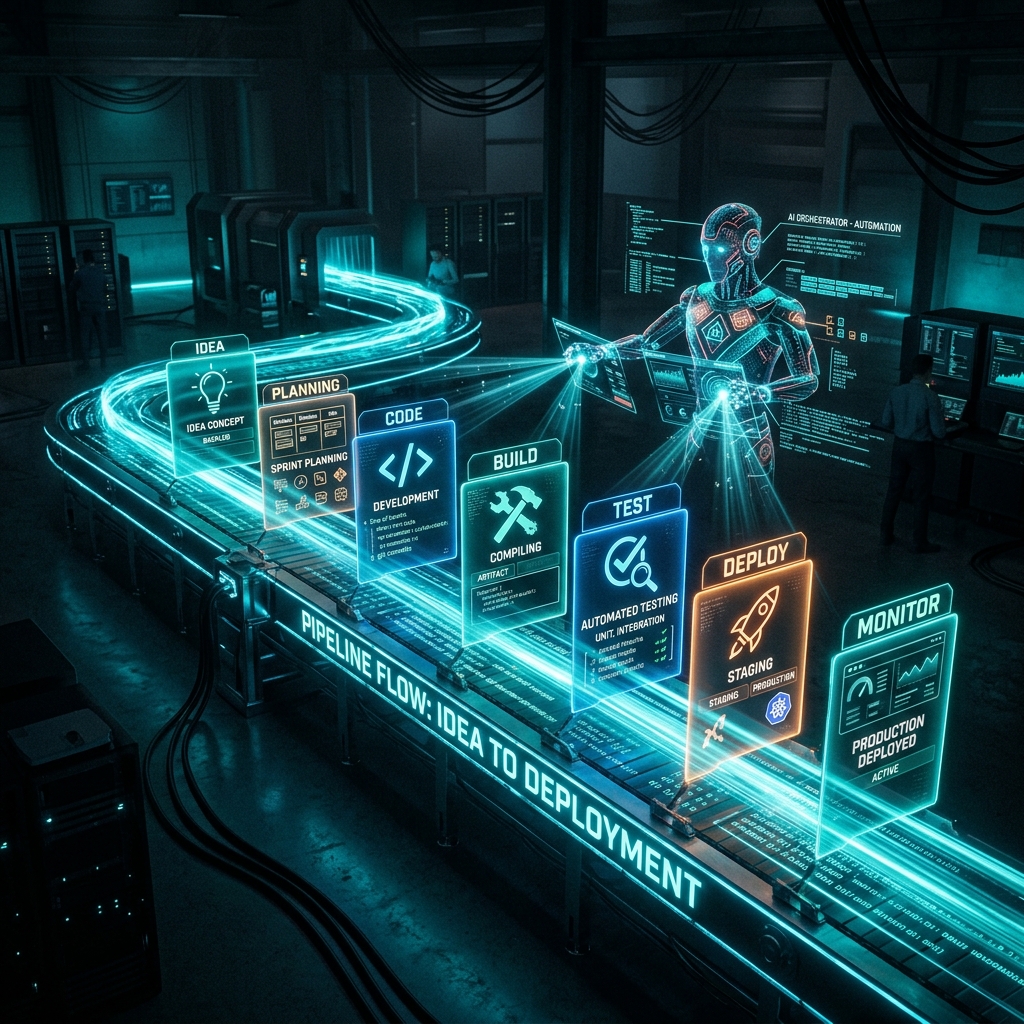
From the nascent spark of an idea to the final push into production, AI agents are proving to be indispensable partners. Let's delve into how they’re integrating seamlessly across the software development lifecycle.

1. Requirements Gathering and Planning: Clarity from Chaos

The first hurdle in any project is often translating a vision into concrete requirements. This phase typically involves countless meetings, documentation, and iterative feedback loops. AI agents can dramatically simplify this. Imagine using a powerful tool like ChatGPT Plus to rapidly prototype ideas, analyze vast amounts of user feedback for key requirements, and even draft initial specification documents. Its advanced GPT models can process natural language queries, summarize discussions, identify potential ambiguities, and generate structured user stories or acceptance criteria, providing a robust foundation for development.

2. Code Generation and Development: The Intelligent Co-Pilot

Perhaps the most visible impact of AI agents is in the realm of code generation. Gone are the days of developers writing every line from scratch. Today, AI agents can generate functional code snippets, entire modules, or even suggest optimal architectural patterns based on high-level descriptions. While dedicated coding copilots often take the lead here, general-purpose AI assistants like ChatGPT Plus, with its Code Interpreter, can be invaluable for generating specific functions, refactoring suggestions, debugging complex logic, or explaining unfamiliar code sections. This significantly reduces boilerplate coding, allows developers to focus on complex problem-solving, and enhances code consistency.

SponsoredCompare AI Tools
Open Matrix

3. Testing and Quality Assurance: Automated Precision

Ensuring software quality is paramount, but testing can be time-consuming and prone to human error. AI agents are transforming QA by automating test case generation, identifying edge cases that human testers might miss, and even performing visual regression testing. They can analyze code changes in real-time to predict potential bugs, generate comprehensive test suites, and report vulnerabilities. The analytical power of tools like ChatGPT Plus can be leveraged here to understand complex system behaviors, analyze error logs, and suggest potential fixes, drastically speeding up the debugging process.

4. Project Management and Collaboration: Orchestrating Efficiency

Beyond the technical aspects, AI agents are also enhancing the organizational side of development. They can manage project tasks, track progress against deadlines, identify potential roadblocks, and even optimize resource allocation. For instance, an AI agent could summarize daily stand-up notes, draft progress reports for stakeholders, or proactively alert teams to dependencies. ChatGPT Plus can aid in crafting clear communication, summarizing discussions, or even generating quick project summaries, fostering better collaboration and keeping projects on track.

5. Deployment and Maintenance: Seamless Transition to Production

The final frontier – getting the software into the hands of users – is often a complex dance of CI/CD pipelines, infrastructure provisioning, and monitoring. AI agents can automate much of this. They can generate deployment scripts, monitor production environments for anomalies, predict potential outages, and even initiate automated rollbacks or hotfixes. Post-deployment, these agents continue to be vigilant, analyzing user feedback, tracking performance metrics, and even drafting release notes or support documentation.

The Future is Now

The integration of AI agents across the dev pipeline is not just about automation; it's about augmentation. It’s about empowering developers to be more productive, creative, and strategic by offloading repetitive or complex tasks to intelligent systems. At AgentCritiq, we believe this paradigm shift is only just beginning. As these agents become more sophisticated and specialized, the speed, quality, and innovation within software development are set to reach unprecedented levels. The journey from idea to deployment is no longer a marathon, but a streamlined sprint, powered by the intelligence of AI.