Anthropic has officially launched 'Cowork', a groundbreaking desktop agent that allows Claude to interact directly with local files and applications. This move marks a significant shift toward local-first AI, empowering users with advanced automation across all desktop software without the need for complex API integrations.
Every few months, a product launch genuinely reshapes how we think about the relationship between software and human work. Anthropic's Cowork is one of those products.
Announced in March 2026, Cowork is Anthropic's desktop agent framework β a suite of capabilities that allows Claude to operate not just as a conversational partner but as an active collaborator on your local machine. It can open files, navigate applications, browse the web, write and execute code, and take actions across your operating system with your oversight and approval.
This is the vision of "local-first AI" that researchers have discussed for years. Cowork is the first implementation that feels genuinely production-ready.
What Cowork Actually Does
The description "desktop AI agent" is easy to underestimate. To understand what Cowork represents, it helps to walk through an actual use case.
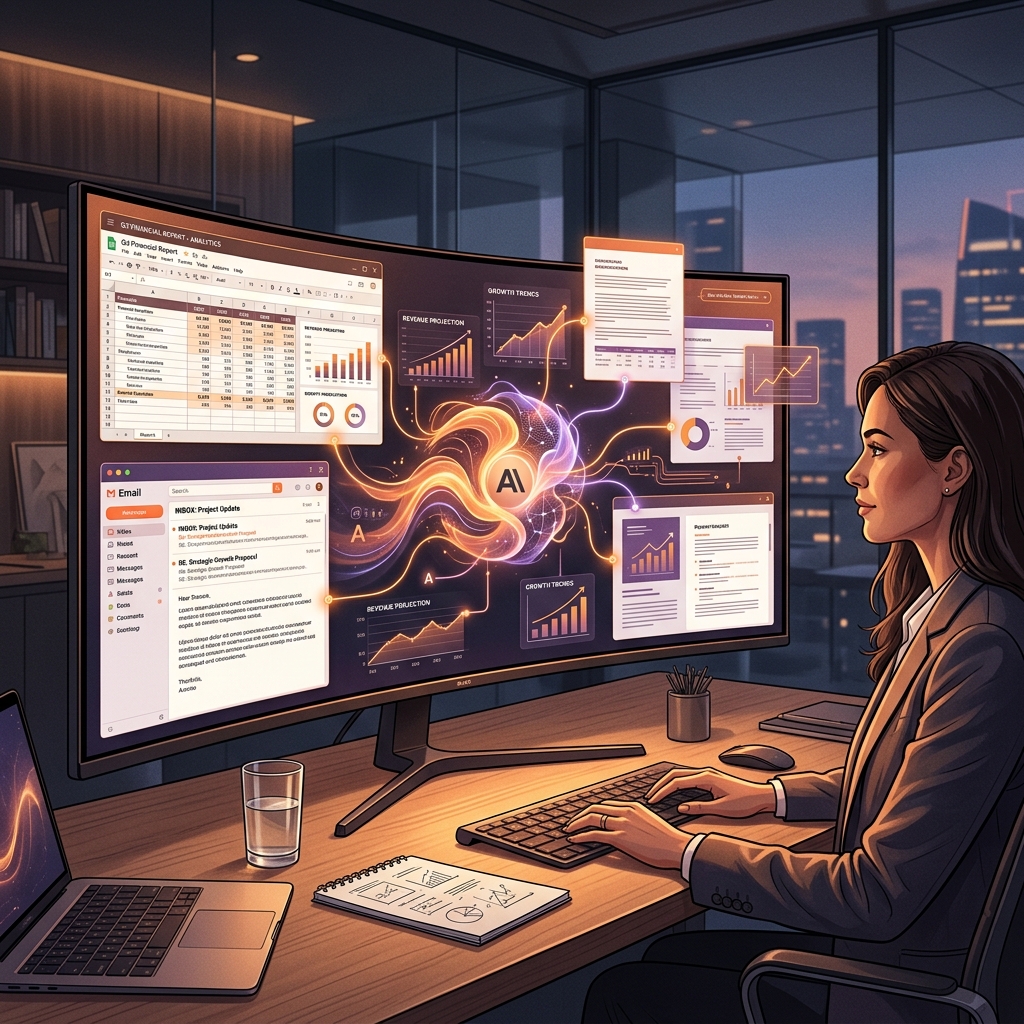
Imagine you're an analyst preparing a quarterly business review. Your data lives across a Google Sheets export, three Notion documents, a folder of PDF reports, and a Slack thread export. Previously, assembling this into a coherent presentation was hours of manual work: copying, formatting, synthesizing, summarizing.
With Cowork, you describe the task in natural language. Claude opens each file autonomously, reads and understands the content, identifies the key metrics and narrative threads, cross-references discrepancies, and drafts a structured presentation β pausing to ask for your input on ambiguous points and showing you its work at each stage.
This isn't a demo scenario. Beta users across enterprise teams have reported completing in 20 minutes what previously took half a day.
"The first time I used Cowork to process our monthly supplier reports, I was honestly uncomfortable with how fast it worked. It felt like I should be doing more." β Supply Chain Analyst, logistics company
ChatGPT Plus
ChatGPT Plus unlocks advanced GPT models, empowering professionals with superior text generation and analytical prowess.
The Technical Architecture: Action + Permission = Trust
What makes Cowork meaningfully different from previous "computer use" implementations is its permission architecture. Earlier systems β including OpenAI's experimental computer use and DeepMind's Project Mariner β operated with relatively blunt permission models: you broadly authorized the agent to use your computer, and it proceeded.
Cowork introduces granular, reversible action permissions. Before executing any significant action (saving a file, sending an email, submitting a form, executing code), Claude describes what it's about to do and why, shows you the specific action in a preview panel, and waits for explicit approval. You can approve once, approve for this session, or approve always for this action type.
This design choice reflects a sophisticated understanding of what makes humans trust AI systems. The bottleneck to AI agent adoption isn't capability β it's confidence. Users need to feel in control even when they're delegating.
Permitted Action Categories (Cowork 1.0)
- File operations: Read, create, edit, rename, organize local files
- Application control: Open and interact with any macOS or Windows application
- Web browsing: Navigate, search, and extract information from public web pages
- Code execution: Write and run code in sandboxed environments
- Calendar and email: Draft, read, and β with explicit permission β send communications
- Cross-app workflows: Multi-application sequences (e.g., "pull this data from Sheets, format it in Docs, and create a Notion summary")
No Code Required: Who This Is Really For
The "no code required" aspect of Cowork's launch marketing is important to understand correctly. It doesn't mean Cowork is limited to simple tasks. It means that the complexity of the task is no longer bottlenecked by the user's technical literacy.
A marketing manager with no programming background can now instruct Claude to "pull our last six months of campaign data from the reports folder, calculate the incremental ROAS for each channel, identify the three highest-performing creative themes by segment, and create a slide deck summarizing the findings with charts." That workflow previously required a data analyst.
A small business owner can instruct Cowork to "monitor our review pages on Google and Yelp, summarize new reviews daily, and draft response templates for any review under four stars." That workflow previously required either a dedicated staff member or an expensive managed service.
The users who benefit most from Cowork are knowledge workers in the middle of the technical literacy curve β people who know what they want to accomplish but have been constrained by the gap between their analytical goals and their tooling capabilities.
ChatGPT Plus
ChatGPT Plus unlocks advanced GPT models, empowering professionals with superior text generation and analytical prowess.
Privacy Architecture: The Local-First Promise
Cowork's most sensitive design challenge was privacy. An AI agent with access to your local files and applications is, by definition, an AI agent with access to everything sensitive on your machine.
Anthropic's solution is a privacy architecture built around local processing as the default. Cowork's action execution engine runs on-device. Only the inference computation β the "thinking" part β is sent to Anthropic's servers, and only the minimum context necessary for the task.
For enterprise deployments, Cowork supports private cloud configurations where even the inference computation stays within the organization's own infrastructure. This makes it viable for financial services, healthcare, and legal environments that operate under strict data residency requirements.
The company has also committed to a clear data policy: Cowork does not retain conversation content or file data, does not use Cowork interactions to train future models, and provides organizational audit logs for compliance purposes.
The Competitive Landscape: Why This Changes the Race
Cowork's launch puts meaningful pressure on competitors. Microsoft has been building toward this capability through Copilot for Windows and the Azure AI ecosystem. Google is pursuing similar territory with Project Mariner and Gemini's growing integration with Google Workspace.
But Cowork's early advantage is coherence. Where Microsoft's AI capabilities are distributed across many products with inconsistent interfaces, and Google's are deeply tied to the Google ecosystem, Cowork presents a unified, cross-application, cross-platform agent with a consistent interaction model.
The developers watching most closely are the ones building the next generation of productivity tools. Cowork's API and agent framework are already generating significant interest among enterprise software vendors who see it as a foundation layer rather than a competing product.
So, who stands to benefit most from Cowork? Pretty much anyone whose day involves navigating a digital deluge of documents. Knowledge workers across industries, from marketing professionals crafting campaign briefs to financial analysts sifting through reports, can expect a significant boost in productivity. It means less time on tedious file management or repetitive data extraction and more time on high-value, creative tasks. For businesses, this translates into unprecedented efficiency gains and a competitive edge. And for the AI community, it's a clear challenge: the race is on to build ever more intuitive, integrated, and autonomous agents that truly augment human capability directly where we work and live. Cowork isn't just a new feature; it's a bold step into a future where AI is less a tool you use and more a partner that works alongside you.