Cookie Consent

We use cookies to enhance your browsing experience, serve personalized ads or content, and analyze our traffic. By clicking 'Accept All', you consent to our use of cookies. Privacy Policy

Meta Drops LLaMA 4: The First Native Open-Source Agent Factory
Back to News
News

Meta Drops LLaMA 4: The First Native Open-Source Agent Factory

Agent Critiq Editorial
April 7, 2026
8 min read

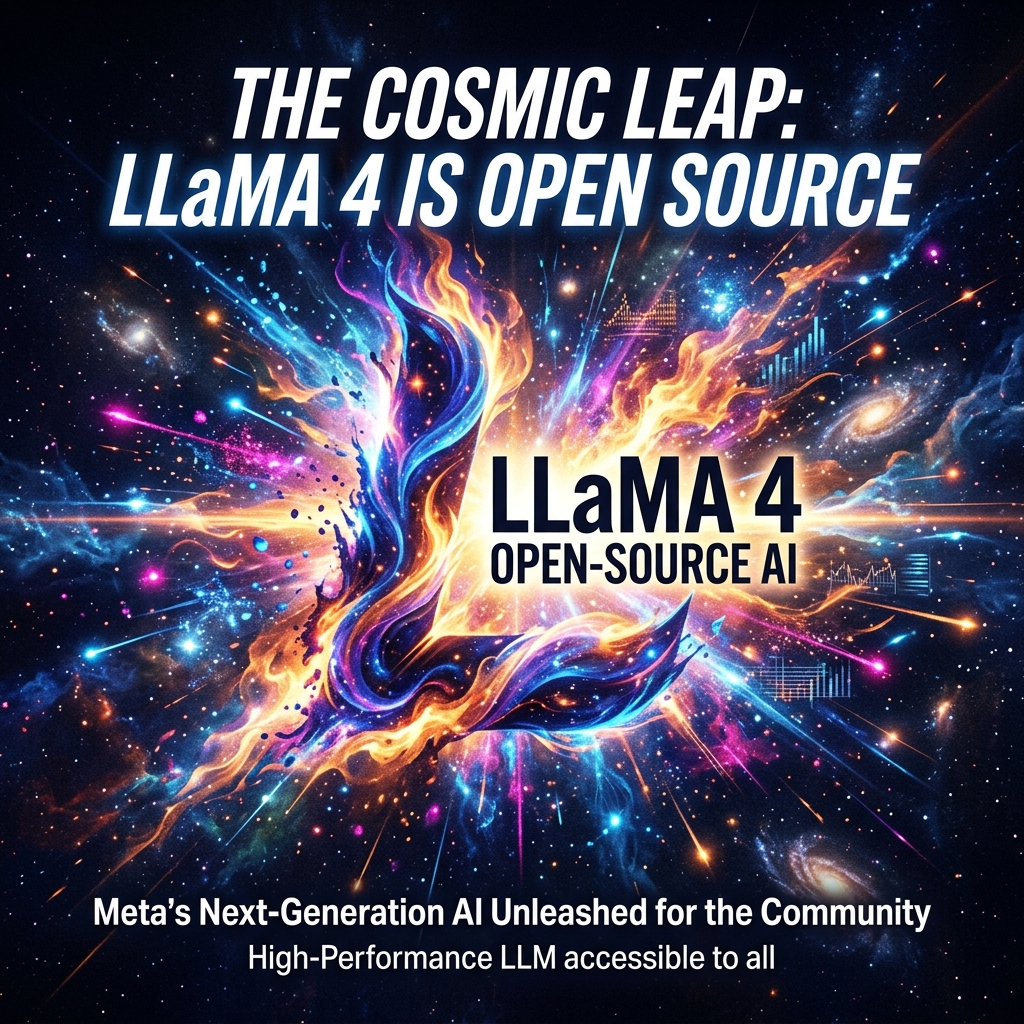
Meta shocks the tech world with LLaMA 4, a game-changing 70B open-source model explicitly built for multi-agent workflows and local environment execution, driving down enterprise costs to zero.

Cover Image ByMidjourney
View Review

In a move that has sent shockwaves through the AI community, Meta has officially open-sourced LLaMA 4 today. But unlike previous iterations, LLaMA 4 isn't just an advanced text predictor—it is officially the world's first native, open-source Agent Factory.

What Makes LLaMA 4 Different?

GPT-4o
EXPERT REVIEW

GPT-4o

OpenAI's flagship omni-modal model — combines text, vision, audio, and code in a single real-time model with sub-second response times.

Read Review

To understand the leap, we must look at how it handles autonomous tasks:

LangChain
EXPERT REVIEW

LangChain

LangChain empowers developers to build sophisticated, data-aware applications by connecting large language models with external data sources and computational tools.

Read Review

The Financial Disruption: Zero-Cost Scaling

For the last three years, startups building AI features have been at the mercy of API pricing. Complex tasks requiring an AI to "think for 10 minutes" could cost dollars per execution.

By cutting out the API middleman, indie developers and enterprises are now spinning up autonomous task forces that run 24/7. Their only cost? The electricity to power the GPUs on their local server racks. We are already seeing companies cancelling their massive corporate API subscriptions in favor of self-hosting LLaMA 4 clusters.

SponsoredCompare AI Tools
Open Matrix

The Developer Community Reacts

The reaction on GitHub and X (formerly Twitter) has been explosive. Within six hours of the model weights dropping on Hugging Face, developers managed to deploy LLaMA 4 agents capable of researching new coding languages, creating a full-stack React app, and self-hosting it—completely autonomously.

"This changes everything for tech startups," tweeted Sarah Chen, a lead AI architect. "We were spending $3,000 a month on cloud APIs for our agent workflows. As of this morning, our entire backend is running locally via LLaMA 4 Swarms. We're keeping our data private and dropping our overhead to near zero."

How to Run LLaMA 4 Locally

Thanks to incredible community optimization, running the smaller 8B worker models is trivial. Using [REVIEW:lm-studio] or Ollama, anyone with a modern M-series Mac or an Nvidia 3060/4060 GPU can run the model locally. For the 70B manager agent, dual 24GB GPUs (like the RTX 3090/4090) are becoming the standard indie-hacker workstation setup.

The Road Ahead for Open Source

Mark Zuckerberg's vision of commoditizing AI intelligence has taken its biggest leap forward. With LLaMA 4 pushing the boundaries of what is possible on consumer hardware, the barrier to entry for enterprise-grade autonomous software has effectively vanished.

The question now isn't whether open source can keep up with Big Tech, but rather: how will closed-source giants compete with a decentralized, free army of highly capable local agents?